
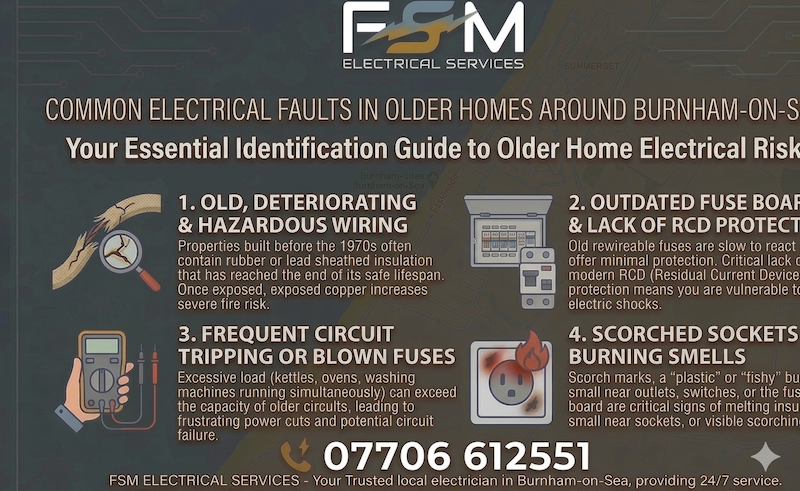
Older homes often have character, charm, and solid construction, but their electrical systems are not always keeping pace with modern expectations. As properties age, faults can start to appear in wiring, accessories, protective devices, and circuit layouts. In many cases, the first step is arranging professional electrical repairs in older homes to identify what is actually causing the issue.
If you own or manage an older property in Burnham-on-Sea, understanding the most common electrical faults can help you act sooner and avoid more serious problems later. This guide covers the issues electricians frequently encounter and explains when repairs, upgrades, or testing may be needed.
Why Older Homes Develop Electrical Problems
Electrical installations do not last forever without deterioration. Over time, wiring can age, accessories can loosen, and older layouts may become less suitable for how households now use electricity. Homes built decades ago were not designed for the number of appliances, chargers, kitchen equipment, and electrical devices that are common today.
As demand increases, weak points in the installation often become more obvious.
Tripping Circuits and Nuisance Faults
One of the most common issues in older homes is repeated tripping. This may be caused by overloaded circuits, deteriorated wiring, moisture affecting the installation, or faults in appliances or accessories.
Although a single trip may not be serious, repeated tripping is a warning sign that something needs proper investigation. It should not be dismissed as normal, especially in an older property where the electrical setup may already be under strain.
Damaged or Worn Sockets and Switches
With years of use, sockets and switches can become worn, loose, cracked, or internally damaged. Some faults are obvious, while others only show up through heat, buzzing sounds, discolouration, or intermittent power.
These issues are often more than cosmetic. A damaged accessory can create poor connections and increase the risk of overheating if it is left in service too long.
Outdated Fuse Boards and Limited Protection
Older properties are more likely to have older fuse boards that do not provide the same level of protection as modern units. In some homes, an ageing board may still be functioning, but that does not mean it is offering the best level of safety for today’s electrical demands.
Where the board is outdated, concerns often lead to a review of consumer units and fuseboards as part of improving the installation overall.
Flickering Lights and Inconsistent Power
Flickering lights are another common issue in older homes. While the cause can sometimes be simple, the problem may also point to loose connections, worn fittings, or faults within the circuit. Inconsistent power to certain rooms or fittings should always be checked if it becomes a recurring pattern.
Ignoring intermittent faults can make diagnosis harder later, particularly if the issue worsens gradually over time.
Ageing Wiring Hidden Behind Walls and Ceilings
One of the biggest concerns in older properties is the condition of the hidden wiring. Because it is out of sight, deterioration may go unnoticed for years. Wiring insulation can age, connections can weaken, and previous alterations may not always have been carried out to a consistent standard.
This is why older properties often benefit from more than just reactive repair work. Understanding the wider condition of the installation becomes increasingly important as the property ages.
When Testing Makes Sense
If a property is showing recurring issues, or if it has not had the electrics checked for a long time, inspection is often the best next step. Problems in older homes can be scattered across the installation, which makes proper assessment much more useful than guessing based on one visible fault.
That is where electrical testing and safety checks become especially valuable. Testing helps identify underlying concerns and shows whether the system is still suitable for continued use.
When Repairs Are Enough and When Upgrades Are Better
Some faults in older homes can be solved with straightforward repair work. Replacing damaged fittings, correcting a fault on a circuit, or resolving an isolated issue may be all that is needed.
In other cases, the property may need a more strategic approach. If there are repeated faults, an outdated board, or clear signs that the installation is struggling, upgrades may be the better long-term choice. The right answer depends on the age, condition, and usage of the system as a whole.
Typical Warning Signs Homeowners Should Not Ignore
If you live in an older property, arrange professional advice if you notice:
- Repeated tripping
- Burning smells or heat from fittings
- Buzzing switches or sockets
- Flickering lights
- Discoloured accessories
- Loss of power on certain circuits
- An old fuse board with limited protection
These are all signs that the installation may need more than a quick visual check.
Speak to FSM Electrical About Faults in Older Homes
If your property in Burnham-on-Sea is showing signs of electrical wear, repeated faults, or outdated protection, FSM Electrical Services can help identify the problem and recommend the right next step. Whether the answer is repair work, testing, or improvements to the existing system, early action is always better than waiting for the issue to get worse.
Older homes can be made safer and more reliable with the right electrical attention and professional assessment.